Imagine Teams stops working tomorrow morning. Switched off from Washington.
One letter from Washington, and an AI model is gone for Europe. Tomorrow the same mechanism hits the tool your business runs on. Sovereignty is not an IT project, it is an economic-policy one.
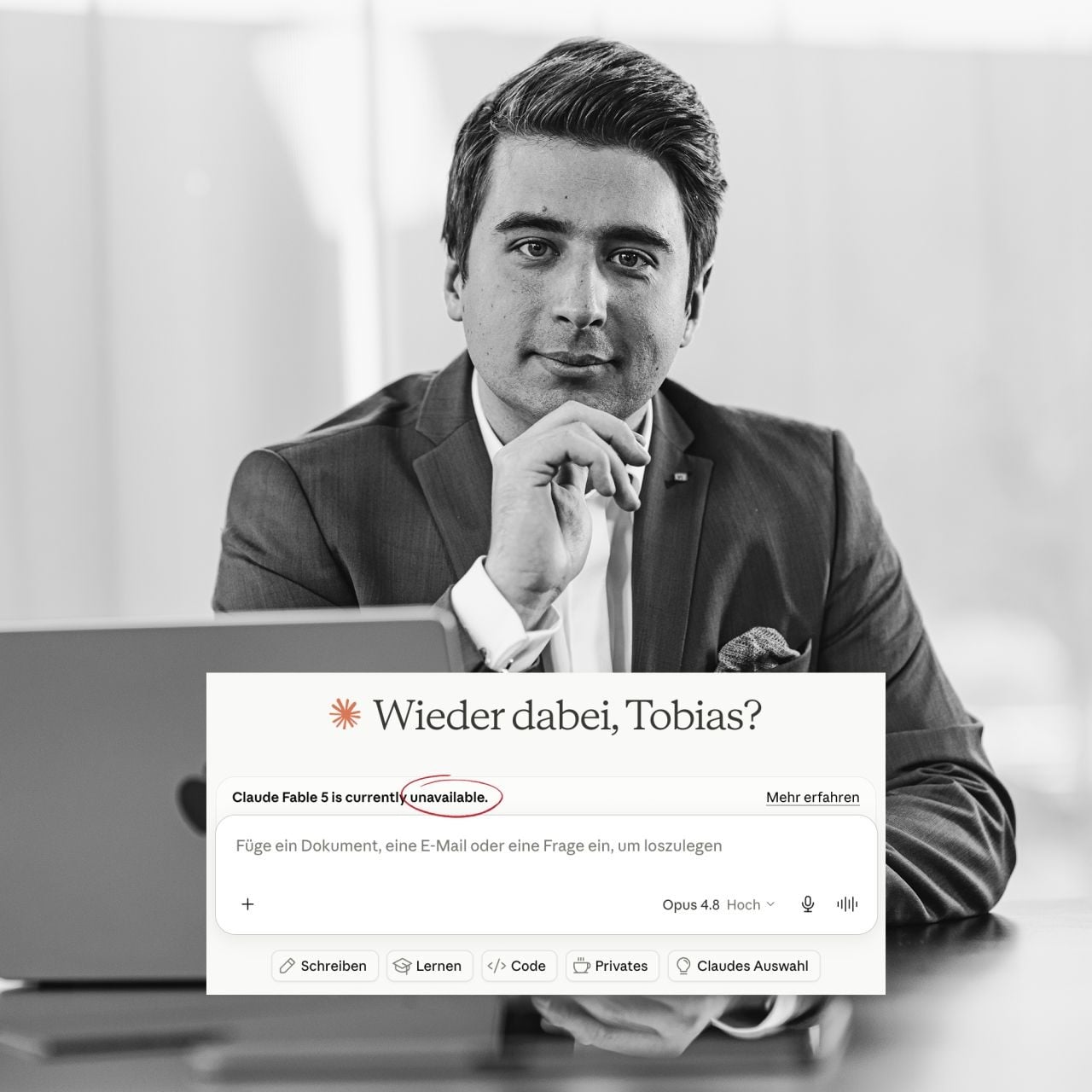
Imagine Teams stops working tomorrow morning. Not crashed. Switched off, from Washington. Sounds absurd? Tonight, exactly that happened. The software just wasn’t called Teams.
Anthropic had to shut down its models Fable 5 and Mythos 5. Not voluntarily, but on the order of the US Commerce Department, based on export control law, “national security”. One letter. No hearing. No proceedings. No plan B.
The ban explicitly hits every foreign national, so us Europeans, and not as collateral damage but as the target. Software that called a model via the cloud ran into an error from one second to the next. No hack. No outage. Someone flipped the switch, and the switch is not in Europe.
Now swap “Fable 5” for “Teams”. Or Microsoft 365. Or AWS. The mechanism is exactly the same: a US agency, a US provider, one letter. What hits an AI model for a few days today is, tomorrow, the tool your entire business uses to communicate, calculate and produce.
And the uncomfortable admission: there is nothing comparable. No European managed service that replaces Teams in bandwidth and quality. We are not dependent because we were lazy. We are dependent because the alternative does not exist.
Not a question for the IT department
This is a question for every board, every management team, every administration and everyone who makes digital policy in this country: what happens to your company, your agency, your school, if the service everything runs on is switched off from Washington tomorrow?
It is not “if”. It is “when and who”.
Sovereignty and the best tools are not a contradiction. But by default, without ever deciding, we chose dependence. Changing that is not an IT project. It is an economic-policy one.
Who is finally going to build the answer? And: have you ever calculated what a single letter like that would cost your business?